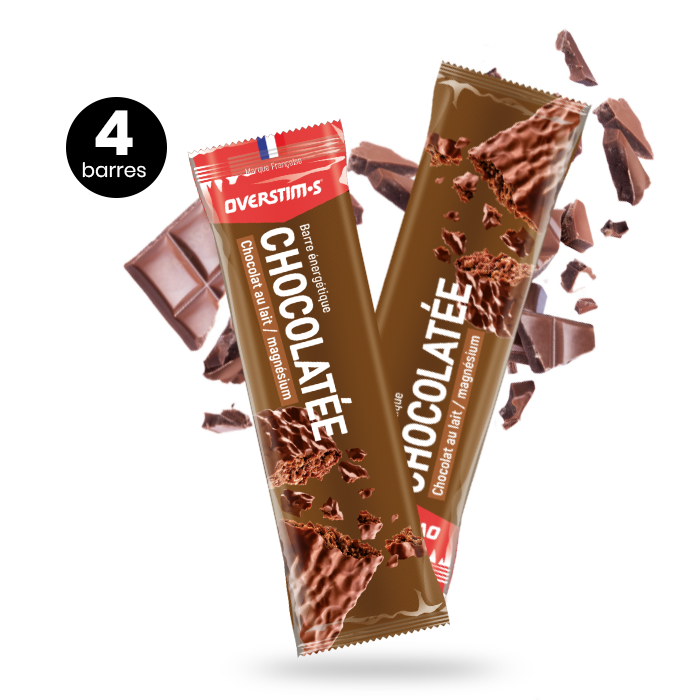
OVERSTIM.s Barre chocolat - magnésium · 4 barres · Chocolat au lait
- 29 g
- Carbohydrates · per serving
- 0 mg
- Caffeine · per serving
- 216 kcal
- Energy · per serving
Suitable for your effort duration?
Choose a duration to explore the overall assessment and the five criteria.
Effort: short · target 45 g/h
Suitable
1.6 servings/h to reach 45 g/h with this product alone.
Strengths
- The score considers ease of eating or drinking on the move and taste appeal over this duration.
Something to check
Factors to watch for estimated digestive tolerance: fat, fibre, protein.
What makes up the score
Carbohydrate contribution1.6 servings/h to reach 45 g/h100/100
A concentrated carbohydrate source, reducing the amount of product needed to reach this target.
Digestive comfortWhat your stomach should handle each hour49/100
To reach 45 g of carbohydrates per hour with this product alone, you would need 77.6 g per hour, about 1.5 servings.
This amount is what matters: 77.6 g of this product means 12.7 g of fat, 8.7 g of protein and 3.1 g of fibre to digest on the move.
Fat: 12.7 grams per hour, far too much: the comfort zone goes up to 2 grams per hour. Fat takes time to leave the stomach, which stays heavy while you run.
Why fat gets in the wayFibre: 3.1 grams per hour, slightly above the comfort zone, which goes up to 2 grams per hour. Fibre bloats the stomach during exercise, can cause urgent toilet stops at the wrong moment and adds to digestive discomfort.
Why fibre gets in the wayProtein: 8.7 grams per hour, slightly above the comfort zone, which goes up to 5 grams per hour. Protein digests slowly and gives no immediate energy: mid-effort, it gets in the way more than it helps.
Why protein gets in the wayPolyols (sweeteners): none in the ingredients, within the comfort zone, which goes up to 1 grams per hour.
To ease digestion, alternate it with a gel or a drink.
Everyone digests differently: try your products in training, never on race day.
PracticalityFormat and taste over this duration82/100
On the move: chewed, slows you a little. Taste: sweet, welcome. Over a short effort, the format counts for 90% of the score, the taste for 10%.
Over a short effort, the format matters most.
Format: soft bar. Fifth of 8 formats, from the meal, taken while stopped, to the drink, taken while running.
A soft texture, easier to chew on the move than a hard bar.
Easier to take on the move: gels, fruit chews and drinks.
Taste
Sugars: 32 g per 100 g, above the sweet threshold of 15 g.
Sweet taste: at least 15 g of sugars per 100 g
A sweet taste that may suit a short effort.
Keep it for moments when you can chew: a climb, a feed station.
Sodium and hydration170.7 mg sodium/h in this scenario69/100
This product would provide 170.7 mg of sodium per hour if it covered your carbohydrate target alone.
Composition1 additive present84/100 · Estimate with missing data
This score combines the product's additives and the share of whole foods in its ingredients.
Additives present : stabilisant : glycérol.
An uncertain identity was excluded from the penalties.
How the overall score is calculated
The score is a weighted average of the available criteria. Their weights are redistributed when a criterion is missing.
- Carbohydrate contribution
- 20 %
- Estimated digestive tolerance
- 30 %
- Practicality
- 30 %
- Sodium and hydration
- 10 %
- Composition
- 10 %
Coverage describes the share of documented criteria, not the reliability of estimates within each criterion.
Estimate with missing data : Composition
Explore the Glyk methodAn uncertain identity was excluded from the penalties.
Effort: medium · target 60 g/h
Combine with other products
2.1 servings/h to reach 60 g/h with this product alone.
Strengths
- The score considers ease of eating or drinking on the move and taste appeal over this duration.
Something to check
Factors to watch for estimated digestive tolerance: fat, fibre, protein.
What makes up the score
Carbohydrate contribution2.1 servings/h to reach 60 g/h98/100
It would take 103.4 g of this product per hour to cover your carbohydrate target alone.
Digestive comfortWhat your stomach should handle each hour43/100
To reach 60 g of carbohydrates per hour with this product alone, you would need 103.4 g per hour, about 2 servings.
This amount is what matters: 103.4 g of this product means 17 g of fat, 11.6 g of protein and 4.1 g of fibre to digest on the move.
Fat: 17 grams per hour, far too much: the comfort zone goes up to 2 grams per hour. Fat takes time to leave the stomach, which stays heavy while you run.
Why fat gets in the wayFibre: 4.1 grams per hour, slightly above the comfort zone, which goes up to 2 grams per hour. Fibre bloats the stomach during exercise, can cause urgent toilet stops at the wrong moment and adds to digestive discomfort.
Why fibre gets in the wayProtein: 11.6 grams per hour, well above the comfort zone, which goes up to 5 grams per hour. Protein digests slowly and gives no immediate energy: mid-effort, it gets in the way more than it helps.
Why protein gets in the wayPolyols (sweeteners): none in the ingredients, within the comfort zone, which goes up to 1 grams per hour.
To ease digestion, alternate it with a gel or a drink.
Everyone digests differently: try your products in training, never on race day.
PracticalityFormat and taste over this duration80/100
On the move: chewed, slows you a little. Taste: sweet, may tire. Over a medium effort, the format counts for 70% of the score, the taste for 30%.
Over a medium effort, the format matters more than the taste.
Format: soft bar. Fifth of 8 formats, from the meal, taken while stopped, to the drink, taken while running.
A soft texture, easier to chew on the move than a hard bar.
Easier to take on the move: gels, fruit chews and drinks.
Taste
Sugars: 32 g per 100 g, above the sweet threshold of 15 g.
Sweet taste: at least 15 g of sugars per 100 g
A sweet taste that may become tiring with repeated servings.
Keep it for moments when you can chew: a climb, a feed station. Alternate with a savoury or neutral product to avoid tiring of sweetness.
Sodium and hydration227.6 mg sodium/h in this scenario59/100
This product would provide 227.6 mg of sodium per hour if it covered your carbohydrate target alone.
Composition1 additive present84/100 · Estimate with missing data
This score combines the product's additives and the share of whole foods in its ingredients.
Additives present : stabilisant : glycérol.
An uncertain identity was excluded from the penalties.
How the overall score is calculated
The score is a weighted average of the available criteria. Their weights are redistributed when a criterion is missing.
- Carbohydrate contribution
- 30 %
- Estimated digestive tolerance
- 25 %
- Practicality
- 20 %
- Sodium and hydration
- 15 %
- Composition
- 10 %
Coverage describes the share of documented criteria, not the reliability of estimates within each criterion.
Estimate with missing data : Composition
Explore the Glyk methodAn uncertain identity was excluded from the penalties.
Effort: long · target 80 g/h
Combine with other products
2.8 servings/h to reach 80 g/h with this product alone.
Something to check
Factors to watch for estimated digestive tolerance: fat, fibre, protein.
What makes up the score
Carbohydrate contribution2.8 servings/h to reach 80 g/h75/100
It would take 137.9 g of this product per hour to cover your carbohydrate target alone.
Digestive comfortWhat your stomach should handle each hour38/100
To reach 80 g of carbohydrates per hour with this product alone, you would need 137.9 g per hour, about 3 servings.
This amount is what matters: 137.9 g of this product means 22.6 g of fat, 15.4 g of protein and 5.5 g of fibre to digest on the move.
Fat: 22.6 grams per hour, far too much: the comfort zone goes up to 2 grams per hour. Fat takes time to leave the stomach, which stays heavy while you run.
Why fat gets in the wayFibre: 5.5 grams per hour, well above the comfort zone, which goes up to 2 grams per hour. Fibre bloats the stomach during exercise, can cause urgent toilet stops at the wrong moment and adds to digestive discomfort.
Why fibre gets in the wayProtein: 15.4 grams per hour, far too much: the comfort zone goes up to 5 grams per hour. Protein digests slowly and gives no immediate energy: mid-effort, it gets in the way more than it helps.
Why protein gets in the wayPolyols (sweeteners): none in the ingredients, within the comfort zone, which goes up to 1 grams per hour.
To ease digestion, alternate it with a gel or a drink.
Everyone digests differently: try your products in training, never on race day.
PracticalityFormat and taste over this duration56/100
On the move: chewed, slows you a little. Taste: sweet, tiring over time. Over a long effort, the taste counts for 60% of the score, the format for 40%.
Over a long effort, the taste matters more than the format.
Format: soft bar. Fifth of 8 formats, from the meal, taken while stopped, to the drink, taken while running.
A soft texture, easier to chew on the move than a hard bar.
Easier to take on the move: gels, fruit chews and drinks.
Taste
Sugars: 32 g per 100 g, above the sweet threshold of 15 g.
Sweet taste: at least 15 g of sugars per 100 g
Sweetness may become tiring over a long effort; varying flavours may be more enjoyable.
Keep it for moments when you can chew: a climb, a feed station. Alternate with a savoury or neutral product to avoid tiring of sweetness.
Sodium and hydration303.4 mg sodium/h in this scenario71/100
This product would provide 303.4 mg of sodium per hour if it covered your carbohydrate target alone.
Composition1 additive present84/100 · Estimate with missing data
This score combines the product's additives and the share of whole foods in its ingredients.
Additives present : stabilisant : glycérol.
An uncertain identity was excluded from the penalties.
How the overall score is calculated
The score is a weighted average of the available criteria. Their weights are redistributed when a criterion is missing.
- Carbohydrate contribution
- 30 %
- Estimated digestive tolerance
- 20 %
- Practicality
- 20 %
- Sodium and hydration
- 20 %
- Composition
- 10 %
Coverage describes the share of documented criteria, not the reliability of estimates within each criterion.
Estimate with missing data : Composition
Explore the Glyk methodAn uncertain identity was excluded from the penalties.
Digestive tolerance varies from person to person. Test products during training.
What this product provides
A serving is an amount of product, not an hourly consumption plan.
| Nutrient | Per serving | 100 g |
|---|---|---|
| Energy | 216 kcal | 424 kcal |
| Energy | 908 kJ | 1,779 kJ |
| Carbohydrates | 29 g | 57 g |
| Sugars | 16 g | 31 g |
| Caffeine | 0 mg | 0 mg |
| Sodium | 110 mg | 220 mg |
| Protein | 5.6 g | 11 g |
| Fat | 8.2 g | 16 g |
| Saturated fat | 3.4 g | 6.8 g |
| Fibre | 2 g | 3.9 g |
| Salt | 0.27 g | 0.54 g |
| Magnesium | 120 mg | 240 mg |
Ingredients
Ingredient analysis is not yet available. The declared ingredient list remains accessible.
Declared ingredient list
Chocolat au lait : Ingrédients : chocolat au lait 24% (sucre, beurre de cacao 24%, poudre de lait entier, pâte de cacao 11,5%, émulsifiant : lécithines ( soja ), arôme naturel de vanille), sirop de glucose, flocons d’ avoine 11,9%, graines de soja caramélisées (sucre, soja , matière grasse végétale non hydrogénée, sirop de glucose, colorant : caramel), billettes de céréales 6,8% (farine de riz, farine de blé , malt de blé , sucre, gluten de blé, dextrose, sel), billettes de céréales 6,1% (farine de riz, farine de blé , gluten de blé, sucre, huile de palme, farine de malt de blé , dextrose, sel), germes de blé , graines de soja , sucre inverti, stabilisant : glycérol, huile de tournesol, protéines de lait , poudre de cacao 2%, dimagnésium phosphate trihydraté, maltodextrine, émulsifiant : lécithines ( soja ), sel. Fabriqué dans un atelier qui utilise : œuf, fruits à coque, sésame
Scan the product you have in your hand.
Glyk identifies the variant and puts its analysis in context for your effort duration.
Discover the Glyk app